
 NL
NL In Overvecht, coffee revolves mainly around the shopping centre, community rooms and social meeting places. From Noordertuin to Medina’s and De Boog, the neighbourhood shapes the flavour.
Roasters in Overvecht
De Laat Coffee
Friedhats Coffee Roasters
Keen Coffee
Mocca d'Or
Nordkapp Coffee
The Village Coffee & Music
Coffee Bars in Overvecht

Oproer Biercafé
Oproer Biercafé in Overvecht serves espresso drinks using coffee from The Village. The article also describes the plant-based policy, the neighborhood function, and the limited public information regarding origin and brewing equipment.
Café Fresco by Panino Fresco
Café Fresco is a coffee bar located on Sint-Maartendreef in Overvecht, next to Panino Fresco. This article covers the location, opening hours, and public information.
Tuincafé Noordertuin
Tuincafé Noordertuin at Steck Utrecht is described through its coffee offerings, vegetarian hospitality, local suppliers, community role, and events in Overvecht.
More over Overvecht
Overvecht: coffee as a community function
Overvecht does not have a coffee culture that evolved around old canals, brown cafes, or narrow shopping streets. The neighborhood took shape after the war, with housing, amenities, and practical spaces for daily use. As a result, coffee here is primarily centered around the shopping center, the station, community centers, lunch spots, and social meeting spaces.
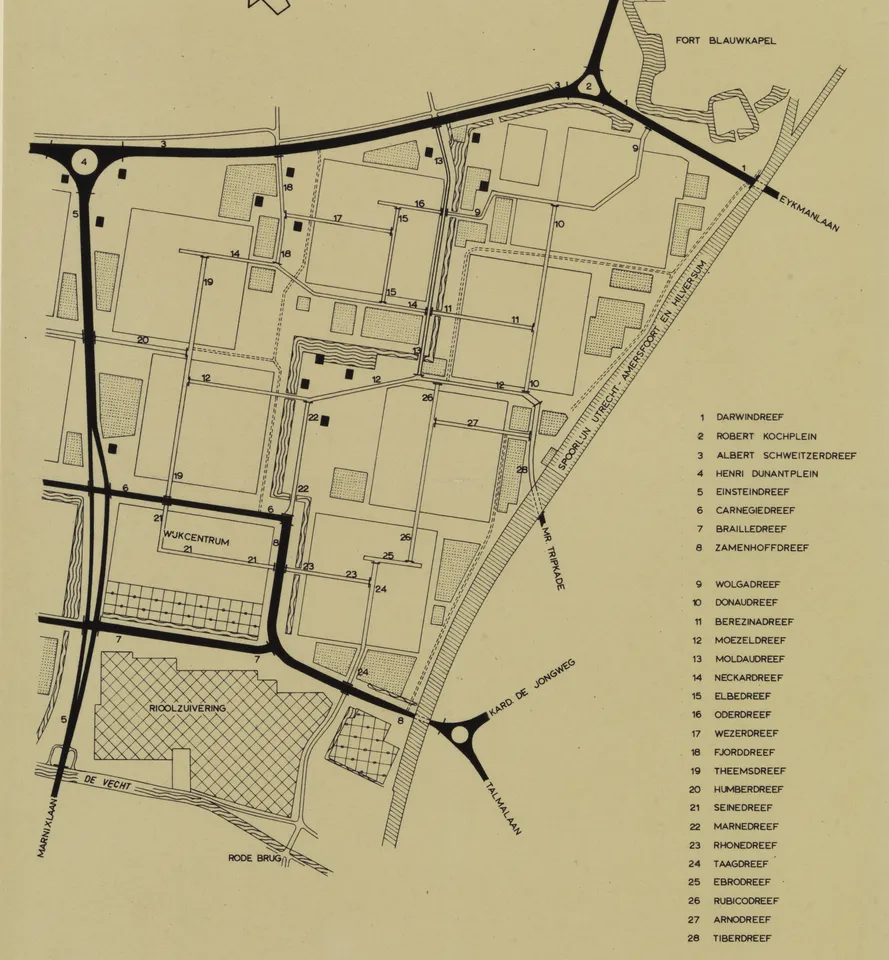
In 1950, Overvecht still consisted largely of meadows, farms, and a water tower. Between 1961 and 1966, the neighborhood was rapidly built as the northern expansion of Utrecht. The city needed housing, and Overvecht was designed as a spacious residential area with clear functional zones.
That planned layout still determines where coffee is visible. The Vecht, the railway line, municipal boundaries, and the Einsteindreef give the neighborhood its structure. Consequently, coffee did not emerge in a compact hospitality street, but at places where residents were already gathering.
From the shopping heart to world coffee
Winkelcentrum Overvecht plays a central role in this story. The center opened in 1969 and grew into the symbolic heart of the new residential area. Today, Overvecht Centrum has more than 100 shops, free wifi, free parking, and various places to eat and drink.
For the hospitality sector, this means that coffee often coincides with grocery shopping, lunch, family visits, or a short break. Café Boost fits perfectly into that pattern. The establishment is located on the central square of Shoppingcenter Overvecht and focuses on coffee, sandwiches, fresh juices, and smoothies.
Medina's Wereldkoffie & High Tea showcases a different side of the neighborhood. Located in Winkelcentrum Overvecht, the establishment combines coffee with matcha, sweets, sandwiches, high tea, table styling, and event catering. The concept feels more like a community-focused meeting spot than a classic specialty bar.
The BKRY also aligns with the neighborhood's modern taste trends. Their menu centers around matcha, iced coffee, coffee bubble tea, strawberry cups, taro matcha, and croffles. The focus here isn't on single-origin filter coffee, but on sweet, recognizable, and shareable beverage moments.
Specialty, but on an Overvecht scale
Overvecht isn't a dense third-wave coffee district. Yet, there is a clear specialty-adjacent player. Tuincafé Noordertuin, located on the Steck grounds at the Gageldijk, serves coffee from the Utrecht roaster Nordkapp. The menu includes espresso, cappuccino, and flat whites.
The beans are roasted in Kanaleneiland. While Noordertuin doesn't have its own Overvecht-based roaster, it does have the most concrete link to local quality coffee. Furthermore, the café fits into a broader environment of greenery, local cultivation, and seasonal produce.
Oproer Biercafé also deserves attention, although coffee isn't the main product there. The large location on the Beyaertdreef serves as a meeting place for residents and beer enthusiasts. Visitors can also stop by for coffee and cake, workspaces, study spots, games, and events.
The neighborhood defines the taste
The demand for coffee in Overvecht is closely linked to the composition of the neighborhood. In 2025, Overvecht had 36,124 inhabitants, 16,961 homes, and 17,800 households. Of these homes, 79 percent were rentals. This makes the neighborhood large, residential, and socially diverse.
Heritage also plays a visible role in the local offerings. In 2025, 36 percent of residents were of Dutch origin, 9.3 percent of European origin, and 55 percent of non-European origin. This helps explain why world coffee, Moroccan tea, matcha, bubble-tea-style coffee drinks, and halal sweets are so prevalent.
Price sensitivity is equally important. In 2020, 31.5 percent of households in Overvecht lived on an income up to 125 percent of the statutory social minimum. Health monitoring also notes that three out of ten households live below the Utrecht poverty line.
- Noordertuin: espresso, cappuccino, and flat white with Nordkapp beans.
- Medina's: cappuccino, Moroccan tea, high tea, and sweets.
- The BKRY: iced coffee, matcha, coffee bubble tea, and croffles.
- Boost: coffee combined with sandwiches, juices, and smoothies.
Coffee as social infrastructure
Perhaps the most important function of coffee in Overvecht is social. Here, coffee is often not a ritual for connoisseurs, but an accessible reason to step inside. This fits perfectly with a neighborhood where community rooms and public living rooms hold significant meaning.
Buurtkoffie Overvecht in Buurthuis De Boog is a prime example of this. Every Friday from 10:00 AM to 12:00 PM, residents can drop in for coffee or tea and a one-euro toasted sandwich. No registration is required, and visitors are welcome to stay longer for games or bingo.
Buurtkamer de Klop on the Andesdreef keeps coffee ready for residents and welcomes about 80 users per week. The space functions as a second living room, where people receive help with letters, financial matters, loneliness, lunch, and social contact.
De Boog also attracts spontaneous walk-ins during the day. Volunteers pour coffee behind the bar while residents talk for hours. In this way, coffee becomes a simple yet powerful form of community bonding.
Sustainability centers around Steck
The most concrete sustainable coffee line in Overvecht runs through Noordertuin and Steck. Noordertuin works with seasonal products from local suppliers and entrepreneurs. Edible flowers and vegetables also grow on the grounds, making coffee part of a broader local food narrative.
Additionally, ’t Zwamcafé uses coffee grounds as an educational byproduct. The organization demonstrates how people can grow mushrooms using used coffee grounds. This gives coffee waste a second life as a raw material.
Overvecht thus demonstrates its own coffee logic. It is not the expensive pour-over bar that takes center stage, but the neighborhood, the family, the lunch break, and social contact. This is precisely where the value of this neighborhood lies for hospitality entrepreneurs and coffee makers.